Showing posts with label AUTOart. Show all posts

Monday, June 5, 2017

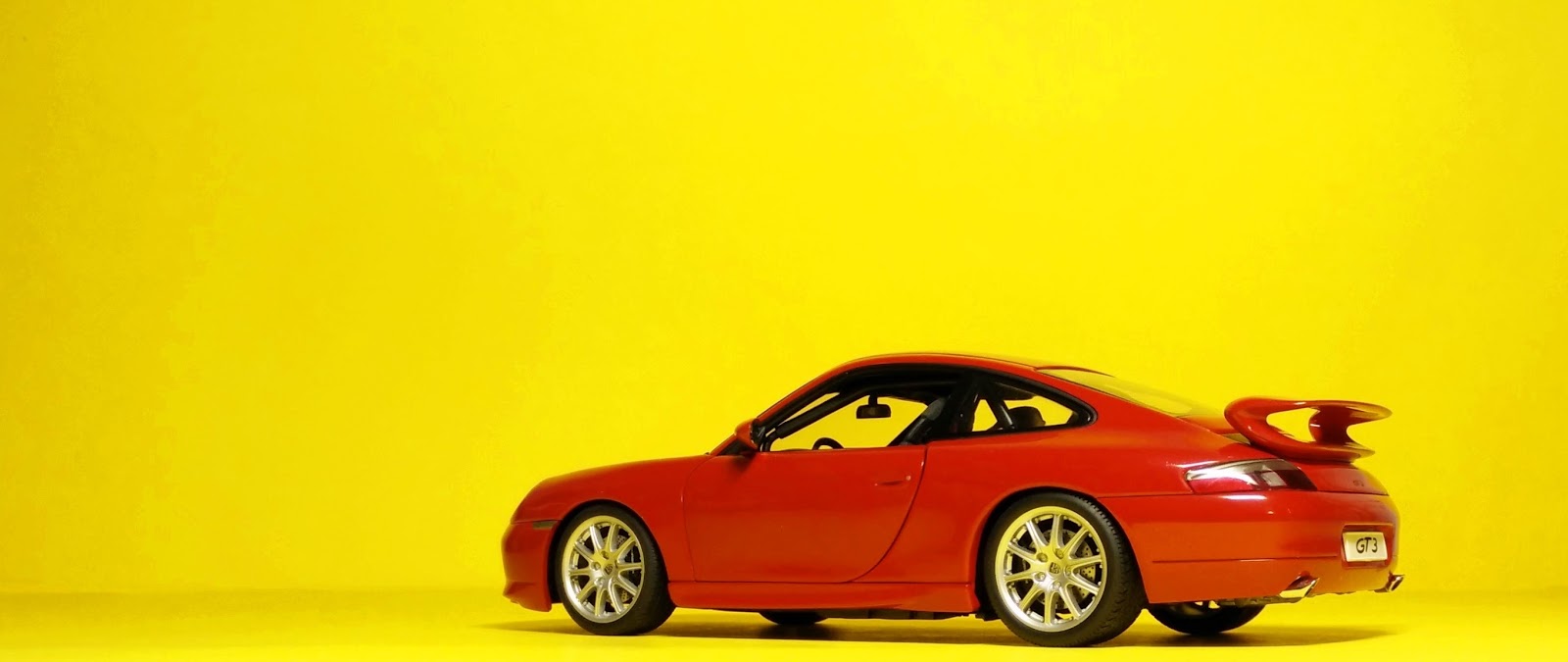
The Porsche 911 (996) GT3, by AUTOart (1/18)


You either love or hate the 996-generation Porsche 911 Carrera. Often dubbed the "runny egg" 911 (and not in a good way) because of the odd shape of the headlights, the 996 is seen by many as the one sore spot of arguably the most legendary sports car lineage of all time. While those lights look more like jellybeans to me, you can never go wrong with eggs either. Eggs are tasty, much like this car right here.


It's AUTOart's 996 GT3, and it's yet another gem of a model. Compared to the Turbo and GT2 variants, the GT3 possesses more subdued styling, with a rounder front fascia, fewer air ducts, and more simplistic wheels. In short, take the wing off and you have what looks like an entry-level 911, not a top-of-the-line, supercar-beating machine. I was never a fan of the GT3 until this one won me over, and that's a testament to how great the AUTOart model is despite its age.


While most older AUTOarts have numerous, creaky plastic parts and feel rather light for eighteenth scale cars made primarily of metal, the GT3 stands solid and high-quality. The detail, especially on the wheels on brakes, surpassed all of my expectations. As is the case with 911's, there's virtually nothing to see in the engine hatch, but the interior is well-decorated with carpeting, textured racing buckets, red seat belts, roll cage, and even a fire extinguisher in the passenger footwell. This is amazing stuff for high-end models of today, let alone an early AUTOart product.




Monday, January 30, 2017

The Wangan King: The Porsche 930 Turbo "Blackbird", by AUTOart

If you're a collector, you already know what this is. Late last year, AUTOart wowed us all with the glorious 1/18 scale model of the Devil Z from the cult-classic Wangan Midnight manga series. They've brought the house down once again with their equally-stunning version of the Devil's nemesis. The Blackbird has arrived, and it's here to rip apart the hearts of Z diehards.


The Devil gets most of the fanfare, thanks in large part to the hot commodity that is JDM these days. But in the script, it plays the underdog role. It never stands a chance against the evil 'Bird, which is just too fast, too powerful. In this case, AUTOart has made both of them winners. You can't really pick just one, so you have to get both. If you get one, you're gonna need the other, as they look amazing as a pair.


Both are de-badged and highly-modified versions of their stock forms. I can't comment on the accuracy of the models because I've never read the manga, but they surely are not the ones depicted in the movie. When they look this good, it ultimately does not matter. The extreme styling of the Blackbird has proven to be very popular, and there are numerous tuning companies out there (RWB, for one) that make a killing re-bodying old Porsches. Drop it a few inches, widen it some, and add never forget the tail. Go ahead and stare.


Thursday, January 26, 2017

Who Did It Better? AUTOart vs. Kyosho in the Battle for Godzilla Supremacy


Two of the marquee brands in diecast. Two GT-R's. Two heavyweights going against each other, but there can only be one winner.

 
This dark grey AUTOart Nissan GT-R (R35) is my latest acquisition. If you've been keeping track, this my fifth R35 (with dozens more in 1/64), and I'm not even ashamed to admit how much I love the car. People want it to be this and that. They want it to look as beautiful as an Italian exotic. They want to be coddled as if they're driving a German. They want the back end to swing out when you nail the gas around a corner, like an American. Guess what? That's not what Godzilla is about. It's distinctly Japanese, as it should be. It's a purposefully-built, Gundam-styled, technologically-advanced machine that flat-out gets the job done. 


Back in the day, when I had just started getting into diecast, when the R35 GT-R was still an otherworldly marvel, AUTOart and Kyosho both introduced their eighteenth scale models of Godzilla at around the same time, stirring debate from collectors and fans alike. Both models sat at around the same price point, so it was a natural comparison. Who did it better? 


The younger me would read all the talk on the forums, scroll through the photos, and form my own opinion based on what I saw through pixels, letters, and hyperbole. At the time, it was undoubtedly the AUTOart for me, but it ultimately made no difference. I was like one of those internet guys who talked the talk but didn't walk the walk. I had zero intention of owning either, let alone getting myself caught up in the high-end model car game. 

Things change. Now I have them both, and I get to be the judge.


Keep in mind that these are actually two slightly different versions of the R35 GT-R. The Kyosho is the left hand drive version that we get here in the states; the AUTOart is true JDM. That explains a few of the minor differences such as the color of the indicators, some of the engine details, and the roof antenna that is present on the silver example. Despite that, it's always interesting and surprising to see how two different companies have two very different ways of replicating essentially the same car. 

In the grand scheme of things, these two are actually incredibly similar to one another as far as accuracy is concerned. Most overlapping models out there have a clear stud and a clear dud. If you didn't want to read the comparison, I would just tell you now that you can't go wrong with either, and that the final verdict is more subjective than it is qualitative. 

No toys were harmed in the making of this review.

If you come across these models, in person or in photos, there is one definitive indicator as to which is which: the wheels. Kyosho opted for the always-stylish gunmetal finish on their wheels, wrapped with thicker tires. AUTOart went with the standard silver wheels (there are variants with matte black wheels that go for more than $300 these days) and tires that look brutally emaciated in comparison - and believe it or not, these are completely true to the real car. 

Behind the wheels, we have the brakes, and AUTOart continues to uphold its commitment to accuracy. The Kyosho has discs whose slots are far too large and noticeable; however, I do prefer its more metallic finish. 


Overall proportions and bodywork are excellent on both, serving as a reminder of why you pay top dollar for these models. The rest lies in the fine details.

It may be hard to see from all the chrome, but Kyosho went all in with the headlights.
The AUTOart has a more accurate exhaust, with a better finish and a properly-angled cut at the end.
Unsightly hinges on the Kyosho are also very awkward to operate and cause excessive panel gap.
Love the wiring on the AUTOart, but the Kyosho has better mouldings for its engine components. Also of note: AUTOart's carbon fiber print on the grille vs. Kyosho's textured pattern.
Do underpanel details matter? According to Kyosho, yes. Yes they do.
No contest here - just look at the hinges.
+1 to AUTOart for the photo-etched GT-R emblem on gills. -1 for the blurry photo.
The GT-R's interior may not be much, but this one is super nice.
Where did the leather stitching go? Also, the carpeting material is unrealistic.

So here's what we've got. The AUTOart is virtually the unanimous winner when it comes to the exterior. If you want the most accurate R35 on the market, it's the one to get. The Kyosho wants to remind everyone that it's the inside that counts, but interior details often get overlooked when it comes to scale models. 


Forget all of that. If you're familiar with these models, if you've read all the discussion, if you've ever considered getting one of these, you'll know there's really only one deciding factor:

The color of the wheels. 

And that's really the great equalizer here. The Kyosho can be an inferior model, but it will still win over your heart with those slick gunmetal wheels. That's where I stand in this comparison. I'll take the Kyosho, please.

Or, you know, both!


Family portrait.